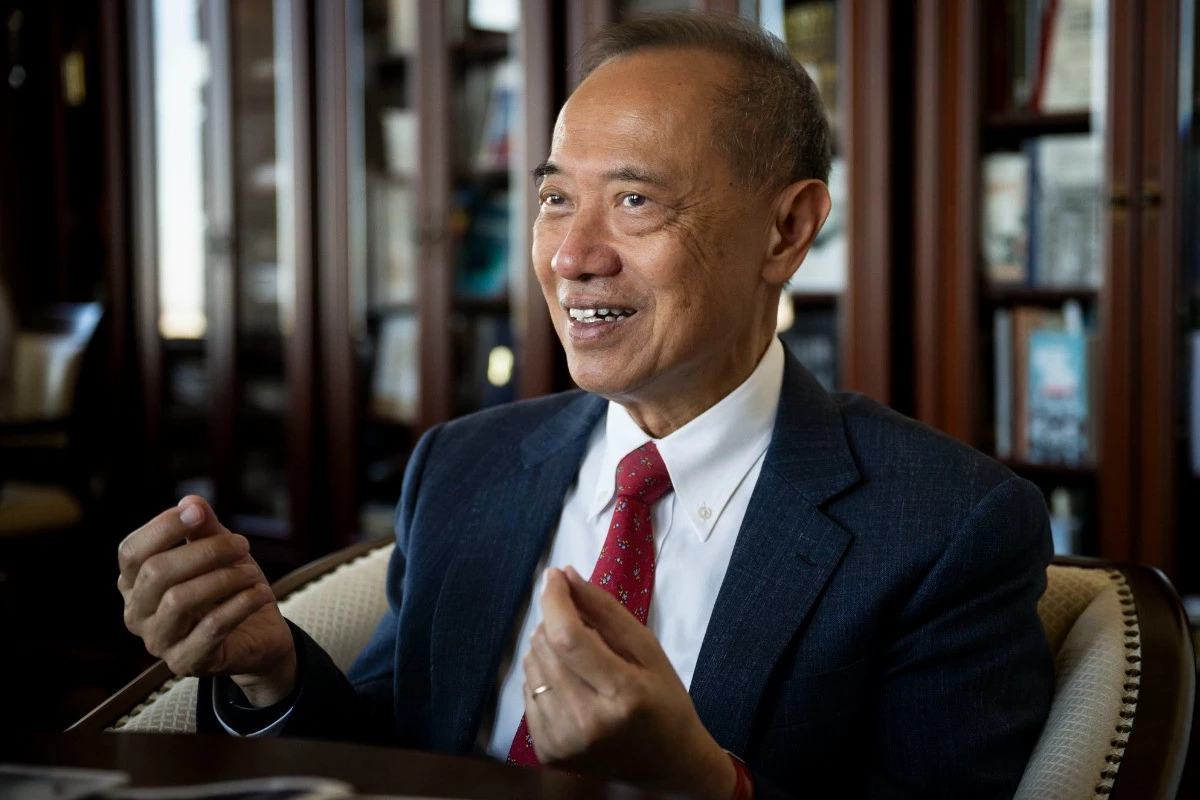
Photo: Róbert Hegedüs
Mariann Őry
25/11/2025 08:00
How do you see the current state of East–West cooperation, taking into account the war in Ukraine and the emergence of new, non-Western forms of collaboration?
I don’t think the East–West dichotomy is very useful in explaining what is happening in the world today. It may once have been, but the world is increasingly dissolving into multipolarity. And the West is not just America. The war in Ukraine, for a short period, solidified the West and revived the North Atlantic Alliance. NATO, which Emmanuel Macron once described as “brain dead”, suddenly became full of life again.
Donald Trump, however, wants to end the war. So America, from leading the Western alliance, now occasionally prefers to act as a mediator. The result is a period of crisis in Europe, where leaders originally committed to total confrontation with Russia over Ukraine are now having to find a way to reach a peace agreement. New leaders may take different political positions to move Europe forward in this next phase of its history. And America, instead of being directly involved, now prefers to be a peacemaker — this is a dramatic change.
Trump says Europe must increase defence spending to 5 per cent. Spain refuses, but everybody else agrees. Now imagine if Germany continues spending 5 per cent of GDP every year. In ten years, Germany will be a significant military force. And if you have your own military capability, the next time America tells you what to do, you’ll say, “Well, let me think about it.” On a number of issues, Europe has different interests from America — in the Middle East, vis-à-vis Russia, in Africa, and in relations with China. So, in a strange way, Trump is fast-forwarding the future.
What do you mean?
He is bringing forward a world in which Europe will be a separate pole — close to America, but articulating its own vital interests and therefore intermediating between other major powers. In the East, yes, China will become very big, but so will India. This will mean a different polar structure in Asia. In between, there is South-East Asia, which is not a strong military force but has a large population and a significant economy, and it will play a different role. So it is more useful to think of the East as China, India, and South-East Asia, and the West as Europe and America.
Where do you see Singapore’s role, or how do you see the country’s options? Should it align with one of the poles, or rather act as a connecting force between them?
Singapore doesn’t want to choose. Our population is three-quarters ethnic Chinese, so we cannot make China an enemy. At the same time, for defence and our financial system, we are very dependent on America. So we can’t have America as an enemy either. Other ASEAN countries don’t want to choose either. This is where ASEAN becomes very important. If ASEAN has clarity, then all of us can rally behind ASEAN to take a common position. And I believe that none of the big powers wants ASEAN to lose its neutrality.
Do you think Donald Trump is content with a scenario where there is a multipolar world and the United States is just one of the poles, or does he want to return to the unipolar era? Would that even be possible?
I think the Trump administration is the first U.S. administration to openly talk about a multipolar world — but one in which the U.S. is the most powerful. This allows the U.S. to play a balancing role in different regions without expending too much effort, thereby making it more effective.
Trump has come to this conclusion partly because, financially, the U.S. is in serious deficit, and the weaponisation of the U.S. dollar and the global financial system exposes it to the risk that the dollar may no longer remain the world’s reserve currency. Once the dollar loses this exorbitant privilege, the entire American financial system is in danger, and its ability to finance military bases around the world will be at risk.
So, the U.S. is not in a very strong position, and leaders like Trump recognise this. That’s why he tells European countries to pay more. With other countries, he tries to bully them using tariffs and insists that they must invest in the U.S. All these are signs of weakness, not of strength. It shows that America knows it can no longer dominate the world as it once did.
What America wants now is to consolidate its own hemisphere. That’s why he talks about making Canada the 51st state, about Greenland, about taking over Panama, threatening Venezuelan President Maduro, and renaming the Gulf of Mexico the “Gulf of America”. He wants to consolidate America around a core in North and Central America. He may succeed in doing that. America can recover, but it will take time. It did not come to this position overnight, and it cannot get out of it overnight either. You need another 20 or 30 years, if the right things are done in the coming years.
And how do you think Europe is navigating the changing situation?
A big problem in Europe is the lack of coherent leadership. In the major countries — France, Germany, and Britain — domestic politics makes it very difficult for strong leaders to emerge. Without strong leadership in France and Germany, it is difficult for the European Union as a whole to have strong leadership. The result is an inability to take strategic, long-term positions. Everyone is worried about the next election and how to win it — and that’s quite sad.
When others look at Europe, they see not strength, but weakness and, to some extent, confusion. The war in Ukraine has made this much worse. It’s like in karate: you think you can smash the brick in half, you try, but you can’t — and all that force goes back into your hand and body, causing internal injury. That is the problem Europe faces today: a lot of internal injury caused by the war in Ukraine.
The ASEAN countries are proud of their effective and peaceful cooperation. Could the EU be a bit more like ASEAN? Would a change in the structure of cooperation help?
No, it’s not possible, because the EU is much more diverse in terms of history, economic development, and political systems. We in ASEAN don’t have a common budget. We have much lower ambitions than Europe.
Europe’s problem lies in defining realistic limits for enlargement and integration. The founding principle of Europe was subsidiarity, a Catholic idea that you should never take away more authority than is absolutely necessary for the collective. Over the years, that principle has largely deteriorated, replaced by a strong push to systematise and control everything. The tension between Hungary and Brussels reflects this. Hungary doesn’t want to lose its identity, uniqueness, or autonomy, whereas Brussels seeks uniformity and will punish those who do not conform.
This is not just about Hungary — other countries in Europe are also unhappy. Europeans are proud of their own heritage. You travel 200 kilometres and you are in a different region, charming in a different way. You can’t take that out of Europe. It’s in the fabric of Europe — it’s what makes it beautiful, allows it to make a great contribution to the world, but also explains why Europeans have so often fought one another. The European Union was an attempt to transcend that past by creating unity in diversity.
What went wrong?
Unity in diversity requires a sensitive dynamic balance. Too much unity is bad; too little is also bad. Unfortunately, I think Europe has gone a little out of balance. It must restore more autonomy to nation states so that they feel more in control and more willing to act responsibly.
In this regard, Central European countries have different aspirations from Western Europe. When you go to Paris, London, or Berlin, sometimes you feel that these are no longer European cities — they have become cosmopolitan. And I can understand why people are not happy about that. Central Europe still maintains its charm and homogeneity. That’s not a bad thing. It doesn’t mean being xenophobic — it means not losing your own character, your own sense of self. And without a sense of self, a person cannot be strong. This is the European drama.
What is your view of Hungary’s strategy? What advice would you give to the Hungarian leadership?
Singapore and Hungary share a kindred spirit. We are relatively small, we live in environments we cannot fully control, and we both want autonomy and agency — to be ourselves. We know that for our economies to function, we must be strong internally: educate our people, have a solid scientific and technological base, and serve others — making a contribution to the world and earning our living that way.
That’s why there is a similarity between the Hungarian and Singaporean characters. Hungary, of course, has a long history, surrounded by Germanic, Slavic, and Latin peoples. You are from Asia; you have your own identity, of which you are proud. And you have guts — sometimes too much. Sometimes your friends from far away worry for you. But there is a tenacity in the Hungarian spirit. What Balázs Orbán wrote in The Hussar Cut illustrates this well. Sometimes Hungary takes risks it should not rationally take, simply because it feels it is the right thing to do.
Right now in Europe, they are trying to cancel Hungary, but you refuse to yield. You say: “No, no, no. You can cut the Erasmus programme. You can deny me subsidies. But I stand firm.” Hungarians are proud of that — and rightly so. In the end, being proud of yourself and standing up for your own principles is what truly matters.
The author is Deputy Editor-in-Chief of Eurasia