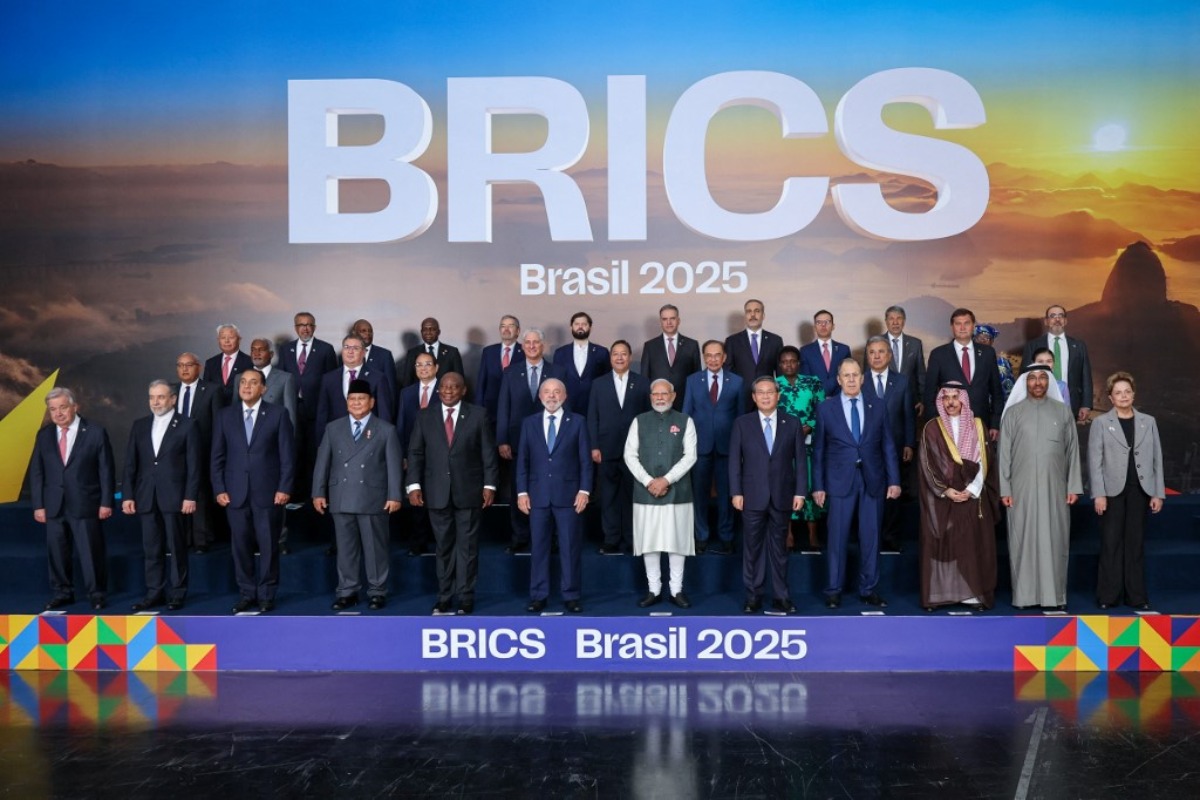
Photo: AFP/Xinhua/Liu Bin
Dr. Zhang Weipeng
28/12/2025 17:53
Cold War mentality, hegemonism, and protectionism remain prevalent. Problems such as the under-representation of the Global South and the weakening effectiveness of international institutions are becoming increasingly prominent. New challenges such as climate change and AI governance continue to emerge. Therefore, global governance stands at a crossroad that requires greater unity rather than division, and more cooperation rather than confrontation. To achieve the goal of strengthening and improving global governance, it is important to accurately answer the questions of who governs, how, and for whom. China’s Global Governance Initiative (GGI) is a systematic response to these issues.
The GGI encompasses five core concepts
Firstly, upholding sovereign equality is the prerequisite for global governance. It advocates that all countries, regardless of size, strength, poverty, wealth, have the right to participate equally in international affairs and independently choose their own development paths. The global governance should not be the privilege and tool of a few countries, but should better reflect the interests and demands of the majority of international society.
Secondly, adhering to the international rule of law is the guarantee of global governance. It advocates adherence to the universally recognized basic norms of international relations, such as the purposes and principles of the UN Charter, and opposes to take a selective approach to international law and rules, utilizing or discarding them as it sees fit, and objects to impose rules that serve its own interests in the name of upholding a “rules-based international order”.
Thirdly, practicing multilateralism is the path to global governance. It advocates that international affairs should be handled through consultation among all countries, and the fruits of global governance should benefit the people of all countries. To achieve this goal, the United Nations, as the core platform for practicing multilateralism, must strengthen its authority and central role in global governance, not weaken it. At the same time, other global and regional multilateral mechanisms should build on their strengths, explore ways to play a more constructive role in key areas, and avoid any discriminatory or exclusive arrangements.
Fourthly, advocating a people-centered approach is the value orientation of global governance. The ultimate goal of governance is to meet the aspirations of people in all countries for a better life and ensure that the fruits of development truly benefit the people. If the global governance system cannot respond to the basic demands of people of all countries for security, development, dignity, etc., its authority and enforceability will be greatly reduced. At present, global issues such as poverty and climate change have become extremely urgent. To solve these problems, it is critical to be people-oriented and effectively enhance the well-being of people in all countries.
Fifthly, focusing on action is the principle of global governance. The effectiveness of governance is ultimately tested in practice. Some countries have only signed international agreements and issued joint statements on global issues such as climate change, food security, and cybersecurity, but have been slow to implement emission reduction targets, frequently imposed unilateral sanctions and export restrictions, and abused their technological advantages to build “digital barriers”. We advocate that developed countries earnestly fulfill their responsibilities and provide more resources and public goods, and that developing countries should unite and strengthen themselves and make contributions within their capacity.
These are five core concepts of the GGI. Importantly, it needs to be made clear that China’s promotion of reforming and improving global governance is not to “start from scratch”, but to enhance the execution and effectiveness of the existing system and better maintain the core position of the UN in the global governance system.
How to reform and improve international multilateral platforms?How to continuously improve international rules, ensure that international rules are applied equally and uniformly? Answering these questions at the institutional construction level are of vital importance to the implementation of the GGI. China is a force for action and governance cooperation.
For example, China has conducted fruitful cooperation with the UN, firmly supports UN peacekeeping operations, and takes the lead in implementing the 2030 Agenda for Sustainable Development.
China has initiated the establishment of multilateral financial institutions such as the Asian Infrastructure Investment Bank, the New Development Bank of the BRICS, and the Shanghai Cooperation Organization Development Bank. These institutions focus on the development needs of more countries and promoting more financial governance cooperation.
Chinese companies have undertaken major projects such as the Hungary-Serbia Railway and the Mombasa-Nairobi Railway, creating tens of millions of jobs in countries along the Belt and Road Initiative.
About the climate change, last month, China announced a new round of nationally determined contributions, actively implementing its emission reduction commitments and contributing to the global green and low-carbon transition.
Regarding new frontier governance, China actively advocates for the joint development of rules, addresses governance shortcomings, and promotes international cooperation in areas such as cybersecurity, polar security, and outer space security.
When we discuss global governance, we are not only focusing on grand global challenges, but also discussing the future of every ordinary person. The core of global governance is to ensure that every country has a sense of presence and direction in the international order, and that every rule reflects shared interests. When international financial rules are fairer, developing countries will have access to more development resources. When security cooperation is more pragmatic, regional conflicts can be more effectively managed. When rules in emerging areas are more inclusive, all countries can share in the dividends of technological revolution.
The GGI provides a systematic and operable solution for strengthening and improving global governance. I would like to promote more theoretical and practical study cooperation on the GGI with more friends to fully understand and participate in its practice and actions, and to build more consensus. It is helpful to replace confrontation with cooperation, resolve differences with inclusiveness, and promote the construction of a more just, reasonable, and effective global governance system.
The author is Associate Research Fellow of China Institute of International Studies